
Reviewed · HISTORICAL TOURS
Shanghai Uncommon Historic Sites Tour
Shanghai’s past is not confined to the Bund and skyline. This private tour takes you to a Gothic-Tudor mansion, a striking former slaughterhouse, a Ming Dynasty city wall, and places tied to modern China’s political story. You get a much less polished, more revealing look at how Shanghai grew.
I like the unusual mix of sites and the fact that your guide and driver handle the city’s long cross-town hops. I also like the authentic dumpling lunch, which breaks up the history with something practical and local. The main drawback is the $175 price, which is a serious outlay for one day, especially for solo visitors.
- 1933 Old Millfun turns an old municipal slaughterhouse into an eerie architectural stop.
- Moller Residence brings colonial-era Shanghai to life through its unusual Gothic and Tudor design.
- Zhou Enlai’s former residence connects a private home with the early political story of the People’s Republic.
- The ancient city wall gives you a rare physical trace of Ming Dynasty Shanghai.
- A private vehicle and guide make a scattered eight-hour itinerary much easier to manage.
- Peggy, one guide associated with this tour, is noted for clear English, photography, and help with wider Shanghai plans.
A Different Way to Read Shanghai
This is not a greatest-hits tour. You will not spend the day moving from one famous postcard view to another. Instead, the route links buildings and sites that explain different chapters of Shanghai: foreign influence, industrial growth, old city defenses, Communist Party organization, and the city’s changing public spaces.
That range is the tour’s main strength. You are not simply looking at attractive architecture. At each stop, you get a clue about who had power, how the city made money, how it defended itself, and how modern China took shape.
The day begins at 9:00 am and lasts about eight hours. Since it is a private activity, only your group takes part. That matters here because the stops call for questions and discussion. You can ask for more detail at a political site, move at a slower pace in a historic building, or spend less time somewhere that does not hold your interest.
The itinerary is spread across Shanghai, so the included air-conditioned vehicle is not a minor extra. Without private transport, these sites would be awkward to connect in one day. Hotel pickup is offered, but you should confirm the exact pickup details when booking.
Moller Residence and the Shanghai of Wealthy Outsiders
Your first stop is Moller Residence in the French Concession area. Built in 1936 by Eric Moller, a man who became wealthy through British shipping, the mansion reflects the money and foreign influence that shaped parts of Shanghai before 1949.
The design is the reason to pay attention. Brown roof tiles and Gothic and Tudor details give the building a look that feels far removed from the modern towers elsewhere in the city. It is a useful reminder that Shanghai’s past was never architecturally uniform. You can find Chinese, British, French, and other influences compressed into a relatively small urban area.
The planned visit lasts about an hour, and there is no admission charge. That makes it a low-cost stop within an expensive day. The practical limitation is that the information provided does not promise a full interior tour or a particular set of rooms. I would treat the mansion primarily as an architectural and historical visit, with your guide supplying the context.
This stop works best if you enjoy buildings that tell social stories. The house is not just an attractive old residence. It points to the commercial networks and privileged foreign residents who helped shape early twentieth-century Shanghai.
More Historical Tours in Shanghai:
- Tour of Jewish Shanghai led by a Jewish History Expert
★ 5.0 · 106 reviews - 4-Hour Private Shanghai Art and History Tour
★ 5.0 · 8 reviews - Private Full Day Tour: Shanghai Colonial History Tour
★ 5.0 · 6 reviews
1933 Old Millfun: An Unsettling Industrial Landmark
1933 Old Millfun is probably the day’s most visually unusual stop. The complex once served as the Shanghai Municipal Council Slaughterhouse, described as the largest slaughterhouse in Shanghai. Today it contains restaurants and shops, but the old structure remains the main attraction.
Give yourself time to look up, across, and through the building. Its concrete passages and unusual structural layout create a mood that is quite different from the decorative Moller Residence. The place has an eerie industrial character, and that contrast makes the first two stops work well together.
The tour allows about an hour here, with no admission fee listed. Since restaurants and shops now occupy the complex, the visit is not a museum experience in the usual sense. You are seeing an old working structure adapted for a new purpose. That can be more interesting than a polished display, but it also means the atmosphere may depend on which areas are open during your visit.
One guide and driver team started a day at 1933 Old Millfun, using the building’s architecture as an early focus. That makes sense. Even if industrial history is not your usual interest, this is the kind of stop that gives you a strong visual memory of Shanghai.
Zhou Enlai’s Former Residence and Political Memory
The former residence of Zhou Enlai is a three-story French-style house built in the 1920s. Zhou served as the first Premier of the People’s Republic of China from 1949 until his death in 1976. The property also served as the Shanghai office for delegates connected with the Communist Party.
This stop shifts the tour from commercial and architectural history to political history. You are looking at a home that was also part of the organizational network behind the new Chinese government. The value is not only in the building itself, but in the chance to connect domestic space with major national events.
Plan on about an hour. The site is likely to appeal most to visitors who want a better grasp of China’s twentieth-century political development. If your interests are mainly food, design, or old neighborhoods, this could feel more serious than the earlier stops. Your guide’s explanation will matter here, especially because the building’s importance is not obvious from its exterior alone.
This is also a point where a private tour helps. You can ask for the background you need without being tied to a large group’s pace. The supplied information does not promise a particular exhibit or interior display, so focus on the site’s political role rather than expecting a large museum.
The Ming City Wall at Renmin Lu and Zhonghua Lu
Shanghai’s ancient city wall offers one of the clearest links to the city before its modern commercial rise. In 1553, during the Ming Dynasty, Shanghai built a wall to defend against Japanese pirates. The wall followed the route of today’s Renmin Lu and Zhonghua Lu, measured about 8.1 meters high, and ran for roughly 4.8 kilometers.
Only a short section is built into this tour, with about 30 minutes allotted. That is enough for a focused look, but not enough to make the wall the central event of the day. Think of it as a compact stop that helps you picture the older walled city beneath the modern streets.
I like this part of the itinerary because it prevents the day from becoming a tour of colonial and twentieth-century sites only. The wall reaches back to a different Shanghai, one concerned with defense and local security rather than foreign shipping, industrial production, or Communist Party meetings.
The short timing is also sensible. A wall remnant can be meaningful without needing several hours. Your guide can explain the original route, then the vehicle moves you on to the next chapter.
A few more Shanghai days worth a look
- Authentic Local Food Tour in Central Shanghai
★ 5.0 · 1,382 reviews - Zhujiajiao Water Town and Shanghai City Private Day Tour
★ 5.0 · 1,016 reviews - Private Shanghai Full Day City Tour with Old and New Highlights
★ 5.0 · 995 reviews - Shanghai: Hop-on Hop-off Bus Ticket and Optional Attractions
★ 3.4 · 692 reviews
The Second National Congress Site
The site of the Second National Congress of the Communist Party of China marks a meeting held in Shanghai from July 16 to July 23, 1922. The congress helped confirm an early party direction and belongs to the period when the organization was still forming its structure and goals.
This is a compact but important stop for anyone trying to understand the political roots of modern China. It is not interchangeable with Zhou Enlai’s former residence. The residence helps you think about a prominent individual and working offices. The congress site focuses on a formal gathering that shaped the party’s early development.
The visit lasts about an hour and admission is included. As with the residence, the quality of the stop depends heavily on how well the setting is explained. The building alone may not tell you why the meeting mattered, so use the private format to ask direct questions and connect the details to the rest of the day.
Some visitors will find the political material dense. I would not choose this tour if you want eight hours of relaxed sightseeing with little historical explanation. But if you want a clearer picture of the forces behind today’s China, this stop earns its place.
Waibaidu Bridge and Shanghai’s Changing Waterfront
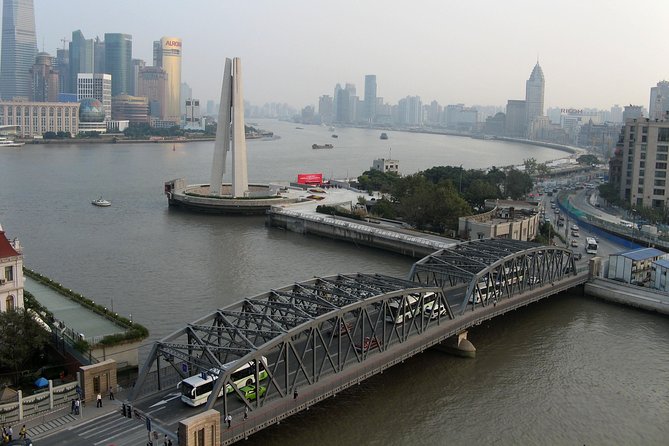
The final listed stop is Waibaidu Bridge, also known as Garden Bridge. It is the first all-steel bridge in China and the only surviving example of a camelback truss bridge in the country. The present bridge opened on January 20, 1908.
The bridge provides a fitting closing image because it brings together engineering, foreign influence, transport, and Shanghai’s public waterfront. After visiting homes, political sites, and old defenses, you end with a piece of infrastructure that shows how the city connected itself to a modern industrial age.
The supplied timing does not give a duration for this stop, so you should not assume a long guided walk. It may be a brief photo and explanation stop within the wider route. Its value comes from seeing the structure in person and understanding why its design and survival matter.
If you have already seen Waibaidu Bridge on another Shanghai visit, this part may feel familiar. The difference here is the place it holds within the wider story. Your guide can link it to the city’s earlier foreign-built infrastructure rather than treating it as an isolated photo stop.
Dumplings in the Middle of a Long Day
Lunch is included, and the meal is an authentic dumpling lunch. That is a welcome practical feature in an eight-hour tour. You do not need to leave the route searching for food, and the meal gives the day a break from buildings, dates, and political context.
The information provided does not specify the restaurant, dumpling style, or menu choices. If you have dietary restrictions, ask before booking rather than assuming the meal can be changed. The tour includes lunch, but tips are recommended, so keep some extra money available for that.
Food also helps keep the day from feeling like a string of lectures. Shanghai’s past is easier to absorb when you have time to sit down, eat, and reset before the afternoon stops.
Is $175 a Fair Price?
At $175 per person, this is not a bargain city tour. The price becomes easier to justify if you are traveling with a small private group and would otherwise need to arrange several taxis, admissions, and a full day of planning.
You are paying for about eight hours, a private guide and driver, hotel pickup, an air-conditioned vehicle, lunch, and all listed admission fees. Several sites have no admission charge, but the value is mainly in the route and the interpretation. These places are scattered and not as easy to combine on your own as the Bund, Yu Garden, and the main museums.
For a solo visitor, the price may feel steep. For two or more people who want a focused day without transport hassles, it can make more sense. Group discounts are offered, so check the current price for your party rather than judging the per-person rate alone.
The tour is often booked about 32 days ahead on average. That is useful planning information, though it is not a guarantee that you must reserve exactly that early. If your Shanghai dates are fixed, booking ahead is sensible.
Guide Style and What to Expect
The guide is central to this tour because several stops need explanation. One guide named Peggy is described as speaking excellent English, taking good photos, and helping with plans for a distinctive Shanghai visit. If Peggy is assigned to your booking, those are useful strengths for a day that combines architecture, politics, and city history.
Do not expect every site to function like a large public museum. Some visits are about a building’s appearance, some about the address and its role, and some about a surviving fragment of the old city. The private format lets you turn those brief stops into a more useful day by asking questions.
The tour is suitable for most participants, is near public transportation, and allows service animals. It is also a private activity, so only your group participates. Confirmation is provided at booking, and cancellation is free up to 24 hours before the start time. After that point, refunds are not provided and changes are not accepted.
Who Should Book This Shanghai Tour?
I would choose this tour if you have already seen Shanghai’s headline sights, or if you want your first full day to explain more than the city’s polished waterfront. It suits people interested in architecture, modern Chinese politics, urban change, and unusual historic buildings.
Families and mixed-interest groups may also find the variety useful. The slaughterhouse complex and bridge offer visual stops, while the residences, wall, and congress site provide material for people who want more context.
I would hesitate if your priority is free time, shopping, or a slow food-focused day. Eight hours is a long stretch, and the route is built around historical sites rather than a relaxed neighborhood wander. Still, for a private, carefully connected look at the less familiar parts of Shanghai, the mix is hard to duplicate on your own.
FAQ
How long does the Shanghai Uncommon Historic Sites Tour last?
The tour lasts approximately eight hours.
What time does the tour start?
The scheduled start time is 9:00 am.
Is hotel pickup offered?
Yes, pickup is offered.
Is this a private tour?
Yes. Only your group participates in the activity.
What meal is included?
An authentic dumpling lunch is included.
Is transportation included?
Yes. The tour includes an air-conditioned vehicle.
Are admission fees included?
All fees and taxes are included. Admission is specifically listed as included for the Shanghai Ancient City Wall and the Site of the Second National Congress of the Communist Party of China. No admission fee is listed for Moller Residence or 1933 Old Millfun.
Is the tour suitable for most participants?
Yes. Most travelers can participate, and the tour is near public transportation.
Are service animals allowed?
Yes, service animals are allowed.
Can I cancel for a full refund?
Yes, if you cancel at least 24 hours before the experience start time. Cancellations made less than 24 hours before the start time are not refunded.
Should You Book It?
Book this tour if you want Shanghai’s overlooked stories, not just its famous views. The strongest reasons are the unusual site selection, private transport, dumpling lunch, and the chance to connect old defenses, foreign-built wealth, industrial architecture, and early Communist history in one day.
Skip it if $175 feels too high or if you prefer to set your own pace. For the right visitor, though, this is a thoughtful way to see a less familiar Shanghai, with enough variety to keep the long day moving.
Newly listed around Shanghai
- shanghai Disney tour★ 5.0 · 12 reviews
- shanghai Disney+shanghai one day city highlights tour (two days)★ 5.0 · 4 reviews
- Zhujiajiao Water Town and Shanghai City Highlights Private Day Tour★ 5.0 · 3 reviews
- Zhujiajiao Water Village & Seven Treasure Town Day Tour from Shanghai★ 4.0 · 8 reviews
- Zhujiajiao Water Town Private Tour with Local Farm Visit and Fruit Picking★ 5.0 · 3 reviews
- Zhujiajiao Water Town Self-Guided Tour with Private Transfer from Shanghai★ 5.0 · 7 reviews
- Xitang Water Town Self-Guided Tour from Shanghai with Private Transfer★ 5.0 · 5 reviews
- Xitang Water Village Sunset Tour with Riverside Dining Experience from Shanghai★ 4.5 · 45 reviews
Historical Tours, compared.
Between Capitalism & Communism: Hong Kong History Tip Based Tour
Read our review →
Beijing Historical Tour II including Summer Palace, Lama Temple & Panda Garden
Read our review →
Beijing Historical Tour I – Forbidden City, Tiananmen Square & Temple of Heaven
Read our review →
Tour of Jewish Shanghai led by a Jewish History Expert
Read our review →
Beijing Historic City Guided Walking Tour + Calligraphy Creation
Read our review →
All inclusive Two-Day Xi’an private Heritage Tour
Read our review →
2-Hour Beijing Private Forbidden City Tour: History & Highlights
Read our review →
Xi’an Full Day Sightseeing Tour – Shaanxi History Museum, Big Wild Goose Pagoda, Ancient City Wall
Read our review →Browse the lists this tour appears in