
Reviewed · WALKING TOURS
Private Half-Day Walking Tour of the New Territories Region in Hong Kong
Hong Kong’s New Territories reveal a very different side of the city. On this private walk, you follow the Ping Shan Heritage Trail through old villages, temples, study halls, and family compounds, with Tsui Shing Lau Pagoda as an early highlight. The route gives you a useful look at village life beyond the towers and shopping streets.
I like the private format, since your guide can adjust the pace and explain details that are easy to miss on your own. I also like the mix of grand ancestral halls and small local features, including the Shrine of the Earth God along Tsui Sing Road.
The main consideration is the walking. The route covers around 5 kilometers and includes some steep slopes, so this is not a gentle stroll for everyone. The $213.20 per-person price also makes the tour best suited to people who value personal guiding and a flexible private group.
Key points at a glance
- Tsui Shing Lau Pagoda: Begin beside one of Hong Kong’s oldest pagodas, a compact but important landmark on the heritage trail.
- Nine historic stops: Visit temples, ancestral halls, a study hall, Ching Shu Hin, and several village sites during roughly four hours.
- Private guiding: Your group travels alone, so you can choose the group size and ask questions as you go.
- Sheung Cheung Wai: Walk through a 200-year-old walled village and see how older village settlements fit into modern Hong Kong.
- Useful transport plan: Start at Tin Shui Wai MTR Station and finish at Yuen Long MTR Station, with hotel pickup available as an option.
- Practical warning: Expect about 5 kilometers of walking, with some steep sections and no food or drinks included.
Why Ping Shan is worth your morning
Many first-time visits to Hong Kong stay on Hong Kong Island, Kowloon, or the main shopping districts. This tour takes you west into the New Territories, where the pace changes and the city’s village past becomes easier to see.
The Ping Shan Heritage Trail links three old villages: Hang Tau Tsuen, Hang Mei Tsuen, and nearby settlements around Ping Shan. Instead of placing the history behind glass, the route carries you along ordinary roads and lanes where temples, family halls, homes, and modern buildings share the same space.
That mix is the real appeal. You are not visiting a single isolated monument. You are seeing how several historic buildings relate to the communities that built and used them. A private English-speaking licensed guide adds value here because the meaning of an ancestral hall or temple is not always obvious from its exterior.
The tour takes about four hours. The advertised start time is 10:00 a.m., and the normal meeting point is Tin Shui Wai MTR Station. Hotel pickup is also offered, which may be useful if you do not want to manage the trip to the starting point yourself.
More Walking Tours in Hong Kong
- Dark Side of Hong Kong – Kowloon Caged Homes Walking Tour
★ 5.0 · 418 reviews - Introduction to Hong Kong: Central Tip Based Walking Tour
★ 5.0 · 202 reviews - Full-Day Private Customized Walking Tour of Hong Kong
★ 5.0 · 106 reviews
Starting at Tsui Shing Lau Pagoda

The walk begins with Tsui Shing Lau, described as one of Hong Kong’s oldest pagodas. It is not the huge, many-tiered monument some people picture when they hear the word pagoda. Its value comes from its age, setting, and place within the Ping Shan community.
Starting here gives the route a clear theme. You are moving through a district where religious buildings, village customs, and family traditions developed together. Your guide can explain why the pagoda matters and place it within the wider trail rather than treating it as a quick photo stop.
The pagoda visit itself is scheduled for about 10 minutes. That is enough time for photographs and a short explanation, but not a long stop. I would keep your camera ready and avoid expecting a large interior visit or an extended museum-style presentation.
From here, the trail continues through Hang Tau Tsuen and Hang Mei Tsuen. These village sections are important because they show the spaces between the major monuments. You may see narrow lanes, older houses, and everyday activity alongside historic buildings. The experience is less about collecting famous sights and more about understanding how the area fits together.
Sheung Cheung Wai and the village experience
Sheung Cheung Wai is a 200-year-old walled village and one of the tour’s most distinctive stops. A walled settlement immediately tells you that older village life was shaped by protection, family ties, and shared boundaries.
The stop is short, around 10 minutes, but its setting gives your guide a useful opening to talk about local people and daily life. You will not simply be pointed toward a wall and sent on. The tour description specifically includes discussion of local residents and their everyday routines as you pass through villages.
That local focus makes the private format useful. You can ask about the purpose of the walls, the arrangement of the settlement, or how older villages fit into the modern district. Since the group is private, your guide does not need to divide attention among strangers.
Still, keep expectations sensible. This is a walking visit through a living area, not a staged historical village. The route passes through genuine neighborhoods, and the emphasis is on observation and explanation rather than entertainment or a long list of formal exhibits.
Yeung Hau Temple and the small details
Yeung Hau Temple receives about 20 minutes on the route. It is one of the major religious stops and gives you time to look at the building, notice its design, and hear about its role.
The tour also includes the Shrine of the Earth God along Tsui Sing Road. This is the kind of small feature that can disappear if you walk the trail without a guide. It may not have the visual impact of a pagoda or ancestral hall, but it helps explain how local religious practice can appear in modest, everyday places.
I like this balance. The route includes major buildings, but it also leaves room for details that do not always make it into a standard city tour. Bring a phone or camera, but do not let photography take over. Several stops are brief, and the guide’s explanation is likely to be the part you remember.
The route also passes a historic police station. The provided schedule does not give it a separate timed stop, so treat it as a feature seen along the way rather than a guaranteed interior visit.
Same base, a completely different kind of day out:
- Hong Kong: Dolphin Cruise, Big Buddha & Lantau Island Tour
★ 4.2 · 1,512 reviews - Ngong Ping 360: Cable Car Return Tickets & Combos
★ 4.6 · 1,431 reviews - Lantau Island Day Trip – Big Buddha & Tai O
★ 4.5 · 1,328 reviews - Big Bus Hong Kong Open Top Hop-On Hop-Off Sightseeing Tour
★ 4.0 · 1,077 reviews
Ancestral halls and family memory
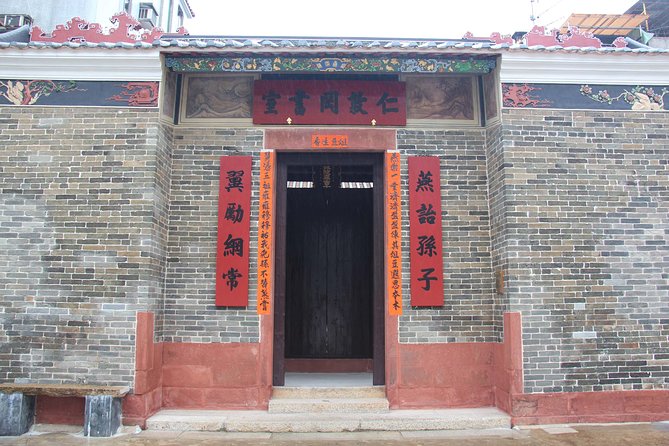
The Yu Kiu Ancestral Hall, Tang Ancestral Hall, and Hau Wong Tang Hall are among the stops that give Ping Shan its strongest sense of family history. These buildings were linked to prominent local clans and served as places for ceremonies, education, and community affairs.
The Yu Kiu Ancestral Hall has around 10 minutes allocated to it. The Tang Ancestral Hall receives about 20 minutes, giving your guide more time to explain its purpose and place within the district.
You should pay attention to how different these halls feel from a regular temple. A temple is connected to worship and religious practice. An ancestral hall centers more directly on family identity, remembrance, and the organization of a clan. That distinction helps the route make sense.
Hau Wong Tang Hall is also included in the walk. The tour information uses both Hau Wong Tang Hall and Tang Ancestral Hall in describing the route, so your guide can clarify the names and connections as you go. Historic places in the New Territories often carry several names or titles, and a live guide is helpful when the labels are not immediately clear.
These stops may appeal most to you if you enjoy architecture, genealogy, or the social history of a place. If you prefer major views, shopping, or food, the halls may feel quiet. Their value is in the explanation and the details, not in spectacle.
Kun Ting Study Hall and Ching Shu Hin
Kun Ting Study Hall is scheduled for about 20 minutes. A study hall adds another layer to the route because education mattered deeply to traditional village families. The building helps show that the trail is not only about worship or defense. It is also about learning, status, and the preparation of younger generations.
Ching Shu Hin is another 20-minute stop. Together, these sites make the walking tour feel more complete. You see religious buildings, family halls, a place connected with study, village walls, and smaller roadside features.
The route is strongest when you take these places as a group. One building alone might be easy to forget. Several different types of historic sites, explained in sequence, create a clearer picture of how the community worked.
This is also where the guide’s local insight matters most. A highly informed and kind guide can turn a plain-looking room or courtyard into something meaningful by explaining who used it and why it was built. The available rating record gives the guide high marks for being well informed, considerate, and able to make the tour enjoyable while covering many interesting places.
Hung Shing Temple and the final stretch
Hung Shing Temple is another major stop, with about 20 minutes planned. Like Yeung Hau Temple, it gives you a chance to see local religious traditions in a setting tied to village history.
By this stage, you will have walked through several different parts of the Ping Shan area. The final stretch works best if you have kept a steady pace. The full itinerary lists roughly three hours for the heritage trail itself, while the overall experience lasts about four hours. The extra time allows for movement, explanations, pauses, and the transition to the ending point.
The tour finishes at Yuen Long MTR Station. This is practical because you are not left at the starting point and forced to retrace the route. If you need help continuing through Hong Kong, ask your guide for directions before parting.
What the private price really buys you
The listed price is $213.20 per person. That is a serious cost for a four-hour walk, especially when all admission stops are free and food and drinks are not included.
The price makes more sense if you are traveling as a small private group and want individual attention. You are paying for an English-speaking licensed guide, local explanations, flexible conversation, and a route that would be harder to interpret alone. A larger group can also make the per-person value more reasonable if the price is calculated according to the selected group size.
The value is weaker if you only want to follow the trail, take photographs, and read basic signs. The buildings themselves do not require paid admission, and transportation to and from attractions is not included. You should also allow about $20 USD, or HK$150, for personal expenses during the tour, though no meal is provided.
For me, this is a specialist half-day experience rather than a bargain activity. It suits someone who wants context and a private pace, not someone searching for the lowest-cost way to see the New Territories.
Walking conditions, timing, and group comfort
The route involves about 5 kilometers of walking and some steep slopes. Wear comfortable shoes and expect a morning spent on foot rather than a series of short vehicle stops.
Most people can participate, but the distance and slopes deserve honest attention. If you have trouble with hills or prefer a very easy pace, ask about the route before booking. The private setup may help because your group can move at its own speed, but it does not remove the physical demands.
The tour is offered in the morning and begins at 10:00 a.m. Starting at Tin Shui Wai MTR Station keeps the meeting point tied to public transportation. Hotel pickup is offered, but transportation to and from attractions is not included as a general tour feature, so confirm the pickup arrangement when booking.
You should bring water, since food and drinks are not included. Plan for weather as well. The experience requires good weather, and poor conditions can lead to a different date or a full refund.
Who should book this New Territories walk
I would recommend this tour to you if you:
- Want to see Hong Kong beyond its best-known urban districts
- Enjoy temples, family history, architecture, and old village settlements
- Prefer a private guide to a large group
- Like asking questions and setting a comfortable pace
- Can manage around 5 kilometers of walking and some slopes
- Have four hours available for a focused morning excursion
I would be more cautious if you have limited mobility, dislike walking in warm or damp weather, or mainly want shopping and food. The tour does not promise a meal, scenic lookout, or major city skyline view. Its appeal is cultural and local.
The perfect group may be two to four people who want an informed introduction to the New Territories without spending a full day away from central Hong Kong. Families and small private groups can also benefit from choosing their own pace.
Should you book it?
Book this walk if you want the New Territories explained rather than simply seen. The combination of Tsui Shing Lau Pagoda, Sheung Cheung Wai, temples, ancestral halls, study buildings, and village lanes gives you a clear look at a side of Hong Kong that many short city visits miss.
The strongest reasons to book are the private format, the guide’s praised personal manner and local knowledge, and the careful mix of large landmarks with small details such as the Shrine of the Earth God. The main reasons to hesitate are the high price for a free-admission walking route and the 5-kilometer distance.
If those drawbacks fit your budget and fitness level, this is a thoughtful, well-focused half-day choice. Free cancellation is available up to 24 hours before the start time, which gives you some flexibility when planning around Hong Kong’s weather.
FAQ
How long is the Ping Shan walking tour?
The overall experience lasts about four hours. The main heritage trail portion is listed at roughly three hours.
Where does the tour begin?
The standard meeting point is Tin Shui Wai MTR Station in Hong Kong. Hotel pickup is also offered as an option.
Where does the tour end?
The tour ends at Yuen Long MTR Station. Your guide can help with directions if needed.
What time does the tour start?
The stated start time is 10:00 a.m.
How much walking is involved?
You should expect around 5 kilometers of walking, including some steep slopes.
Which historic sites are included?
The route includes Tsui Shing Lau Pagoda, Sheung Cheung Wai, Yeung Hau Temple, Yu Kiu Ancestral Hall, Tang Ancestral Hall, Kun Ting Study Hall, Ching Shu Hin, Hung Shing Temple, and other features along the trail.
Is this a private tour?
Yes. Only your group participates, and you can choose the private group size.
What happens if the weather is poor?
The experience requires good weather. If it is canceled because of poor conditions, you will be offered a different date or a full refund. You can also cancel for a full refund up to 24 hours before the start time.
More Half-Day Trips in Hong Kong
- Half-Day Private Custom Tour of Hong Kong
★ 5.0 · 202 reviews - Private Hong Kong Car Tour – Half Day or Full Day
★ 5.0 · 86 reviews - Private Half-Day Real Hong Kong Walking Tour
★ 5.0 · 70 reviews - Peaks to Piers, Half-Day Private Customised Tour In Hong Kong
★ 5.0 · 69 reviews
Newly listed around Hong Kong
- Full Day Private Trip in Hong Kong( impeccable local )walk tour★ 5.0 · 11 reviews
- Hong Kong Victoria Harbour Sightseeing Cruise Tickets★ 4.5 · 8 reviews
- Hong Kong Guided Dinner + Laser Show Lounge Entry (2023) | 200+ booked★ 3.5 · 7 reviews
- Walking Tour in Hong Kong – Local Experience (New & Best)★ 4.5 · 33 reviews
- Victoria Peak Tram and Sky Terrace 428 Admission Hong Kong★ 4.5 · 33 reviews
- STARLIGHT: Victoria Harbour Night Yacht Tour★ 4.5 · 38 reviews
- Group Vegetarian Food & Cultural Tour★ 5.0 · 16 reviews
- Lantau Island Full Day Tour (2024) 150+ booked★ 4.5 · 20 reviews
Walking Tours, compared.
Beijing Hutong Walking Food and Beer Tour at Hidden Restaurants
Read our review →
Private Beijing Walking Tour of the Forbidden City with 7 Options
Read our review →
Dark Side of Hong Kong – Kowloon Caged Homes Walking Tour
Read our review →
Forbidden City Private Walking Tour with Optional Sights
Read our review →
Introduction to Hong Kong: Central Tip Based Walking Tour
Read our review →
Shanghai Highlights Walking Tour With A Real Local
Read our review →Browse the lists this tour appears in