
Reviewed · MUSEUMS
Beijing: China National Film Museum Entry Reservation
China’s film story unfolds across 21 exhibition halls at this large museum in northern Beijing. You’ll move from early cinema through changing periods of Chinese film, see film-making techniques explained, and find displays on major directors and artists. I like the broad sweep of the exhibits and the chance to pair the museum with one of its six cinemas, including an IMAX GT hall.
I also like the low price, about $4.82 per person, and the direct QR-code entry, which avoids a ticket queue. The main caution is language: an English guide is included, but some visitors found the exhibition descriptions were only in Mandarin, so this is easier if you can read Chinese or are comfortable using the visual material.
Key points to know before you go
- A century of Chinese cinema: Floors two through four trace film development across different periods and stages.
- 21 exhibition halls: The museum gives you far more than a small collection of film posters or costumes.
- Six movie halls: The complex includes an IMAX GT hall and seating for more than 1,000 people in total.
- Separate QR code required: The code sent by email or WhatsApp is your admission code. The code inside the booking app is not enough.
- English help, but not everywhere: An English text and visual guide is included, while some labels and descriptions remain in Mandarin.
- Two hours is a useful first visit: You can cover the main exhibition route in that time, but film fans may want longer if a paid screening is available.
A large museum built for China’s film story
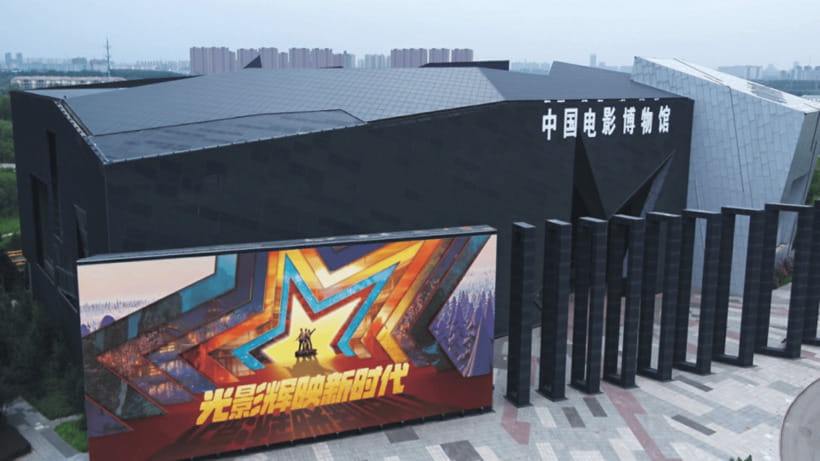
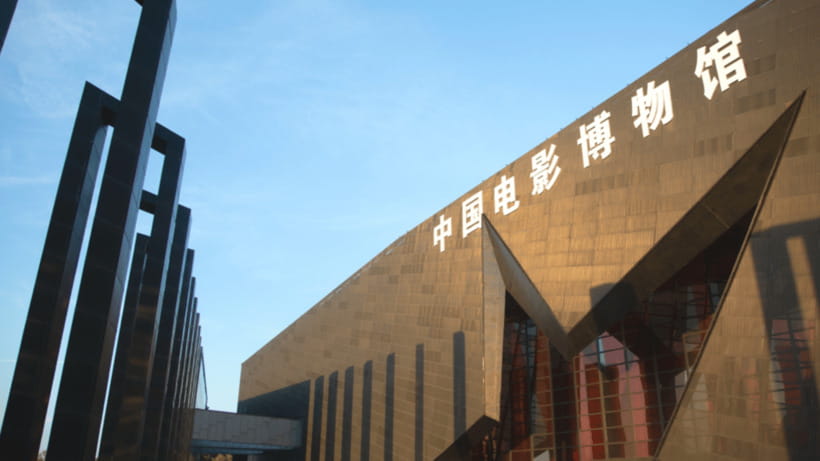
The China National Film Museum opened to the public on February 10, 2007, after being founded on December 29, 2005. It was created as a major public cultural institution, and its size makes that clear from the start.
The museum covers 8.7 acres, with nearly 38,000 square meters of architectural space. The exhibition areas alone cover about 13,000 square meters. I mention these figures because they change your expectations. This is not a quick room of famous movie memorabilia. It is a full-scale cultural museum with enough material for a serious look at Chinese cinema.
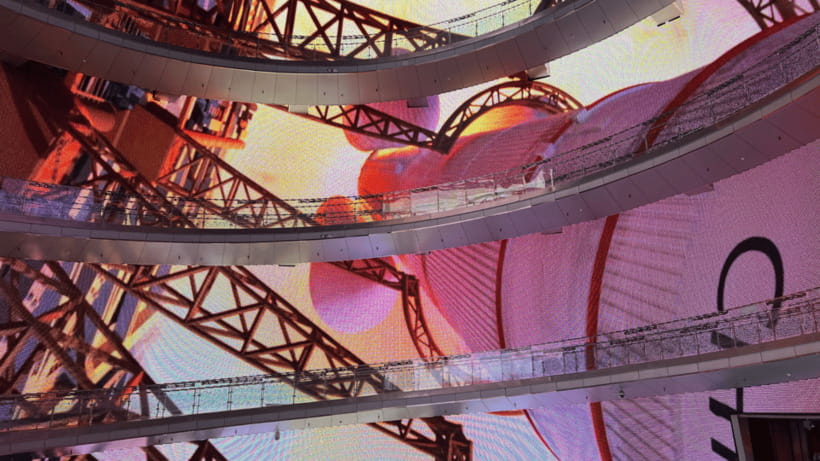
You’ll find 21 exhibition halls spread through the building. Six movie halls add a working cinema complex to the museum, including an IMAX GT hall. The cinemas can hold more than 1,000 people in total, so the building serves both as a museum and as a place to watch films.
The museum is especially useful if you want context before seeing Chinese films in Beijing. Instead of treating movies as isolated works, the displays connect them with different periods of Chinese cultural and artistic development. The experience is less about one blockbuster and more about seeing how an entire national film industry took shape.
More Museums in Beijing
- Beijing: Tianmen Square, Forbidden City & Royal Museum Tours
★ 4.6 · 1,288 reviews - Beijing:Jingshan Park (Palace Museum Garden) Ticket
★ 4.5 · 185 reviews - Beijing Half Day: National Museum of China In-depth Tour with Subway Transfer
★ 5.0 · 70 reviews
Start on the first floor with a modern national story
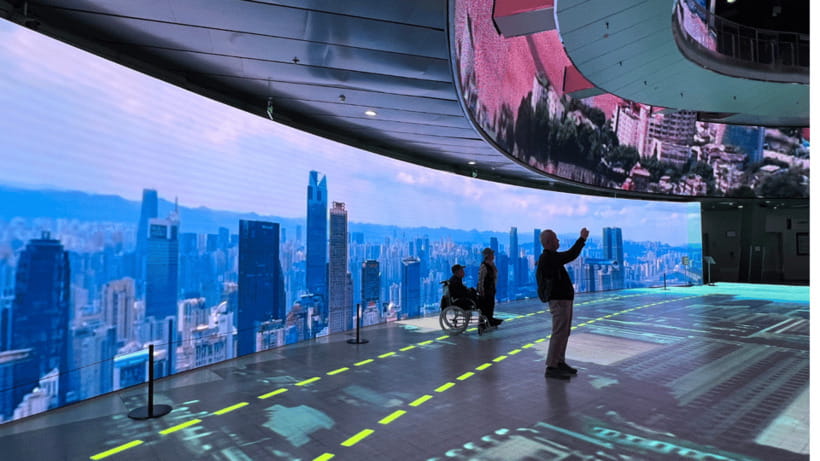
The first-floor exhibition is called A New Journey of Struggle. The title signals a focus on a more recent stage of China’s development and the way film has reflected national change.
I would begin here if you want to follow the museum’s intended route. The first floor gives you a present-day frame, while the upper floors move through the longer story of Chinese cinema. That order makes the museum feel like a progression rather than a collection of unrelated displays.
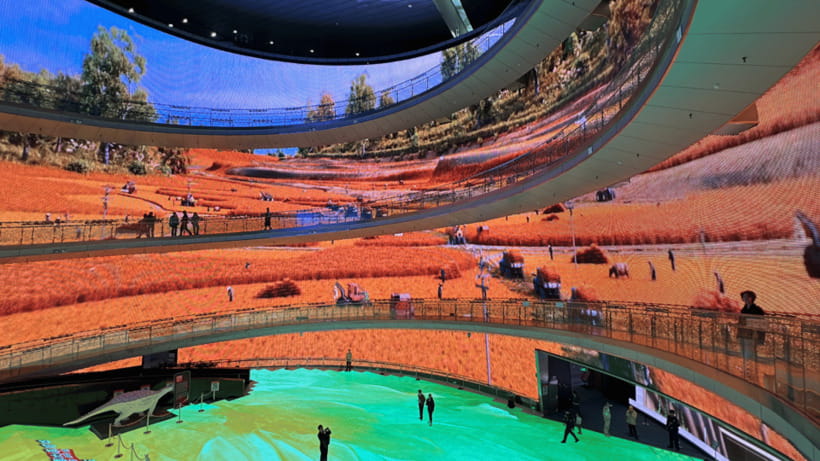
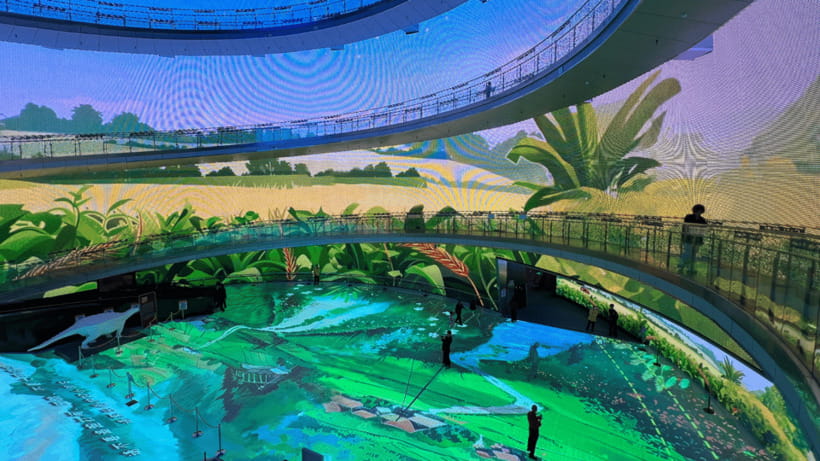
The first floor is also where you may encounter the dinosaur-related exhibition area that has been a highlight for some visitors. The dinosaur displays add variety to a visit that could otherwise focus heavily on film history and text panels. If you are visiting with children, or simply want a visual break from reading, this part may be especially welcome.
The exact balance of film material and other displays can depend on what is open during your visit. Still, the first-floor exhibition gives you a useful opening point and helps explain why the museum is designed as a broad public institution rather than a specialist archive alone.
Follow one hundred years of film on floors two through four
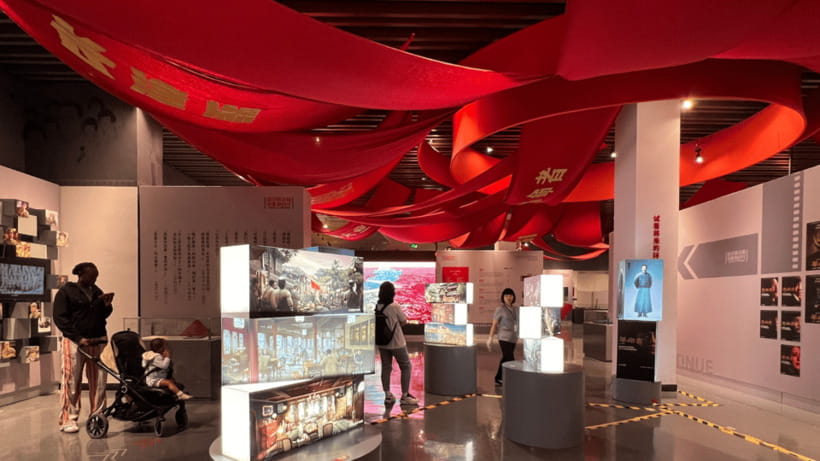
The central exhibition, A Century of History, A Century of Glory, occupies the second, third, and fourth floors. This is the heart of the visit.
Here you’ll see Chinese cinema arranged across different periods and stages. The displays present major artistic achievements by many film-makers and explain how films were made. That second part matters. You are not only looking at finished movies or famous names. You also get a chance to see the work behind the screen.
The museum’s value comes from this broad span. A single film can tell you something about a director or a particular decade. A three-floor exhibition can show how film styles, production methods, and artistic goals changed over time. You may find yourself comparing the look of early film with later productions, or noticing how the museum places film-making within larger changes in Chinese society.
The museum also aims to reveal some of the practical secrets of production. The supplied information does not list every object or display, so I would not arrive expecting a fixed set of specific costumes, cameras, or props. Instead, plan for a mix of film history, visual material, production information, and achievements by important film-makers.
If you read Chinese, you will get more from the full wall text and captions. If you do not, the included English textual and visual guide should help with the main route, but it may not translate every label in the building. One visitor specifically found the descriptions were only in Mandarin, so you should treat the English guide as helpful support, not a promise that every panel is bilingual.
What the six cinemas add to your visit
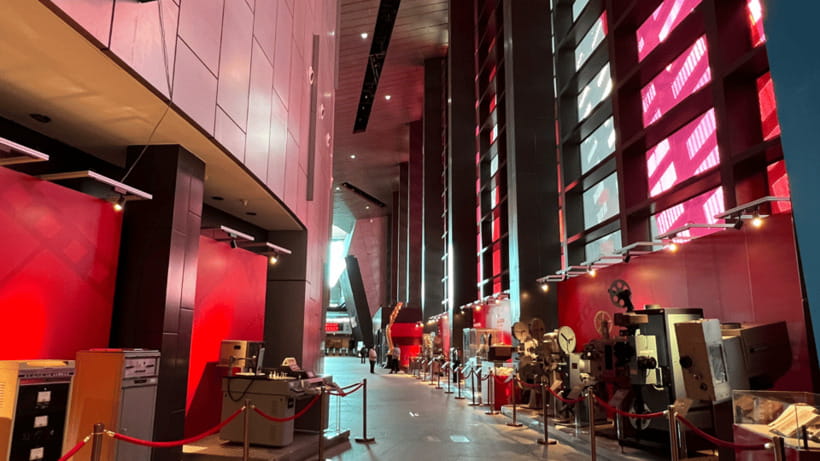
The museum has six movie halls, including an IMAX GT hall. This is a useful feature, but it is important to separate the museum entry from cinema admission.
Your reservation covers entry to the China National Film Museum. It does not cover the cost of a paid movie screening. If you want to watch a film, you should expect to pay separately, assuming a suitable screening is available during your visit.
The cinema complex gives the museum a practical purpose beyond display cases. You can learn how Chinese cinema developed and then, with a separate ticket, see film on a large screen in the same cultural setting. The IMAX GT hall is the most distinctive option named here, especially for visitors who care about presentation as much as subject matter.
For a basic two-hour visit, I would focus on the exhibitions first. A screening can make the outing longer and more expensive, but it may be worthwhile if the film and time suit your plans. Do not assume that the movie halls are included simply because they are inside the museum.
Same base, a completely different kind of day out:
- From Beijing: Mutianyu Great Wall Tours with Options
★ 4.9 · 9,216 reviews - Beijing: Forbidden City Tour(Group/Private)-Tickets Included
★ 4.8 · 7,974 reviews - Beijing: T-Square & Forbidden City Group or Private Tour
★ 4.8 · 4,446 reviews - Beijing: Mutianyu Great Wall Daily Tour with Ticket & Lunch
★ 5.0 · 3,056 reviews
How the QR entry works
The entry process is simple, but there is one detail you need to get right. After booking, you receive an e-ticket by email or WhatsApp. You must use the separate QR code provided there to enter the museum directly.
The QR code shown in the booking app is not your admission ticket. This is the most important practical point in the whole reservation. Check your email or WhatsApp before leaving for the museum, and make sure you can display the correct code on your phone.
You also need your passport. Bring it even if you normally use a digital booking record for attractions in Beijing. Smoking is not allowed inside the museum.
The reservation is wheelchair accessible, and the direct-entry arrangement means you can avoid a standard ticket line. That is a real advantage in a large city where wasted time can affect the rest of your day. You are still responsible for arriving at the correct place with the right code, so do not rely on the app alone.
Is $4.82 good value for two hours?
At about $4.82 per person, this is inexpensive for a museum of this size. The value is strongest if you have an interest in Chinese film, visual culture, or large public museums. For the price, you get access to 21 exhibition halls and the chance to see a building that also contains six cinemas.
The low price does not mean the museum will suit every visitor. If you want a small, highly focused attraction with short bilingual labels and a quick collection of famous objects, this may feel too large and text-heavy. The museum asks you to spend time with its wider story.
I see the reservation as good value for a flexible Beijing day. You can spend two hours on the main route without paying for a screening, or add a movie if you want a longer film-themed outing. The free cancellation option up to 24 hours before the visit and the reserve-now, pay-later arrangement also help if your Beijing schedule is still changing.
The price is particularly useful for repeat visitors to Beijing. You may already have seen the major imperial sights and want something different from palaces, temples, and shopping streets. The museum offers a more specialized look at modern Chinese culture without requiring a full-day commitment.
How much time should you set aside?
The stated duration is two hours, and that is a sensible target for a first visit. I would use the time in three parts:
- Begin with the first-floor exhibition, A New Journey of Struggle.
- Spend most of your time on floors two through four, where A Century of History, A Century of Glory presents the century-long film story.
- Leave time to check the cinema area and decide if a paid screening suits your schedule.
Two hours should let you see the main exhibitions at a steady pace. It may not be enough if you read every panel, pause at each display, and add a movie. Film students, dedicated cinema fans, and visitors who read Chinese may want to allow extra time, though the reservation itself is described as a two-hour experience.
I would avoid rushing through the museum just to claim that you saw every hall. The building is large, and the point is to understand the progression of Chinese film, not to race from floor to floor.
Language is the main issue to weigh
The language question deserves a clear warning. The entry includes an English version of the textual and visual guide, which gives non-Chinese speakers a useful starting point. At the same time, not all descriptions inside the museum are guaranteed to appear in English.
The feedback on this point is mixed in a practical way. Some people find the exhibitions very interesting and the staff friendly and helpful. Others found the Mandarin-only descriptions a serious limitation. Both reactions can be true because the visual displays may be easy to appreciate while the detailed explanation remains difficult without Chinese.
If you cannot read Chinese, focus on the overall timeline, images, objects, film-making displays, and the English guide. You can still understand the broad development of Chinese cinema, but you may miss fine details about individual films and creators.
This is not a tour with a live guide. No guide is provided to explain each room or translate questions. The staff may help with basic practical matters, but you should not book this expecting a guided English lecture.
Who will enjoy this museum most?
I would recommend the museum most strongly to:
- Film fans who want context about Chinese cinema
- Visitors interested in modern Chinese art and culture
- Families who like large museums and may enjoy the dinosaur area
- Repeat visitors seeking an attraction beyond Beijing’s best-known historic sights
- Anyone who values a low-cost, self-guided indoor activity
You may want to think twice if you need full English interpretation at every display. You may also find it less satisfying if you prefer a short attraction built around a few famous objects rather than a large chronological presentation.
The museum works best when you accept its scale and its limits. You are getting a substantial public museum for a small admission cost, not a private guided tour with every label translated.
A practical plan for a smooth visit
Before you leave, confirm that the separate QR code has arrived by email or WhatsApp. Save it where you can open it quickly, and bring your passport. Remember that the booking app code is not the code used for entry.
Plan on about two hours for the main visit. If you are considering a film screening, allow extra time and budget separately, since paid screenings are not included.
Wear comfortable shoes if you expect to explore all four exhibition floors. The building is large, and the 21 halls make this more active than a quick gallery stop. Since smoking is not allowed, plan for a fully smoke-free indoor visit.
I would also keep expectations realistic about English. Use the included English guide, but be prepared for Mandarin captions and descriptions. If film history is a major reason for your visit, that language gap may matter more than it would at a mainly visual museum.
Should you book the China National Film Museum?
Book it if you want a low-cost, large-scale look at Chinese film, especially if you can handle some Mandarin or do not mind relying on an English guide and visual displays. The century-long exhibition, 21 halls, six cinemas, and IMAX GT option give the visit real substance for about $4.82.
Skip it if you need a fully English-language experience or want a live guide to lead you from room to room. The separate QR-code rule is easy to manage, but you must check your email or WhatsApp and bring your passport.
For the right visitor, this is a useful two-hour addition to Beijing. It shows how film developed across different periods, gives you a look at the work behind the screen, and offers a different side of Chinese culture than the city’s imperial monuments.
FAQ
How long does the China National Film Museum visit take?
The activity duration is about two hours. You may need more time if you want to explore the museum slowly or attend a paid movie screening.
What does the reservation include?
It includes entry reservation for the China National Film Museum and an English version of the textual and visual guide.
Are movie screenings included?
No. The cost of paid movie screenings is not included in the museum entry reservation.
Is there an IMAX cinema?
Yes. The museum has six movie halls, including an IMAX GT hall.
Which QR code should I use for admission?
Use the separate QR code sent by email or WhatsApp after booking. The code shown in the booking app is not your entry ticket.
Do I need to bring my passport?
Yes. Your passport is listed as a required item, so bring it with you.
Is the museum wheelchair accessible?
Yes. The activity is listed as wheelchair accessible.
Newly listed around Beijing
- Beijing: Summer Palace Ticket; fast and smooth★ 3.6 · 38 reviews
- Beijing: Summer Palace Entry Ticket★ 3.3 · 3 reviews
- Beijing: Summer Palace Highlight Walking Tour★ 4.8 · 25 reviews
- Beijing: Summer Palace, Sacred Road&Ming Tombs Private Tour★ 5.0 · 8 reviews
- Beijing: Summer Palace 3 Hours Guided Tour with Entry Ticket★ 4.8 · 4 reviews
- Beijing Private Tour: Summer Palace, Panda House and Options★ 5.0 · 21 reviews
- Beijing: Summer Palace Entrance(combo/tour opt)★ 4.7 · 6 reviews
- Beijing Royal Banquet with Chinese culture prefermance★ 5.0 · 3 reviews
Museums, compared.
Tianmen Square, Forbidden City & Royal Museum Tours
Read our review →
Half-Day Mini Group Xian Tour to Terracotta Warriors Museum
Read our review →
Beijing:Jingshan Park (Palace Museum Garden) Ticket
Read our review →
Private Chengdu Day Tour: Giant Pandas and Jinsha Site Museum
Read our review →
Private Xi’an Tour: Terracotta Warriors, Hanyangling Museum, Cave Homes
Read our review →
Beijing Half Day: National Museum of China In-depth Tour with Subway Transfer
Read our review →
Terracotta Warriors Museum Ticket with Professional English-speaking tour guide
Read our review →Browse the lists this tour appears in